A living room can look finished on paper and still feel unsettled in real life. The TV is mounted, the sofa fits, and the coffee table is in place, but cords are visible, speakers sit wherever they fit, and the room never quite feels as calm as it should. That is usually the moment homeowners start looking at custom full-wall media and entertainment centers – not because they want something flashy, but because they want the room to finally make sense.
Unlike a standalone console, a full-wall design treats the whole wall as usable space. It frames the television properly, gives every device a home, and brings visual balance to a room that often carries a lot of daily traffic. More importantly, it solves the kind of clutter that tends to return no matter how often you tidy up.
Why custom full-wall media and entertainment centers work so well
Most family rooms and living rooms do more than one job. They are where you watch movies, store games, charge devices, display family photos, and sometimes even work for an hour before dinner. A small media unit usually handles one of those functions. A full-wall solution can handle all of them without making the room feel crowded.
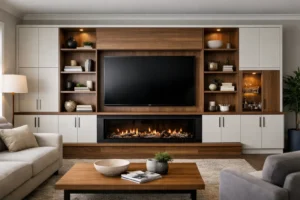
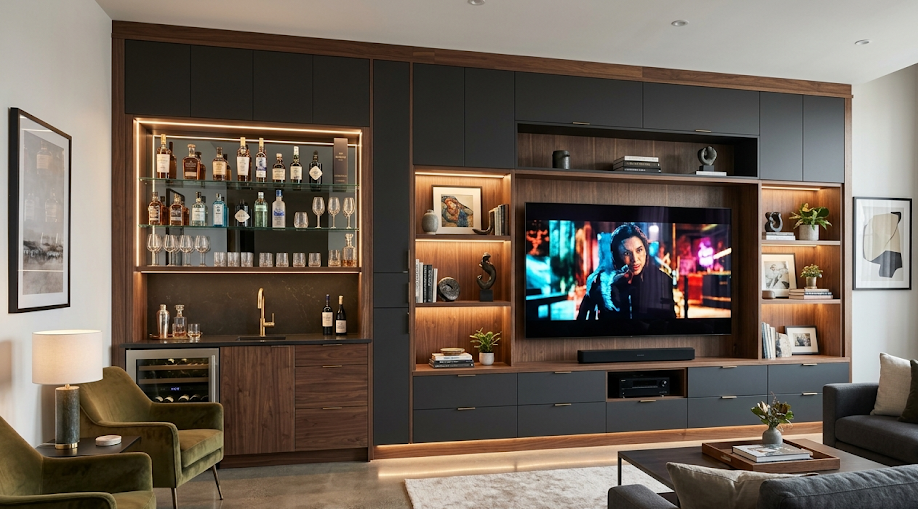
That is the real advantage of custom full-wall media and entertainment centers. They are built around your room, your storage habits, and the way you actually use the space. If you need closed cabinets to hide routers, gaming systems, and kids’ accessories, that can be built in. If you prefer open shelving for books and decor, that can be balanced into the design. If your wall has awkward dimensions, bulkheads, vents, or a fireplace nearby, a custom approach works with those realities instead of fighting them.
There is also a visual reason they feel so satisfying. When cabinetry runs wall to wall, the room feels intentional. The television stops looking like an afterthought. The storage looks integrated rather than added later. Even simple finishes can feel elevated when every line fits the space properly.
What makes a built-in feel timeless instead of trendy
It is easy to get distracted by inspiration photos. Bold paint, dramatic lighting, and statement hardware can look great online. In a home you live in every day, the better question is whether the design will still feel right five or ten years from now.
The most successful custom full-wall media and entertainment centers usually start with proportion, not decoration. Cabinet depth matters. Shelf spacing matters. The size of the TV opening matters. A design that feels calm and tailored tends to outlast one that tries too hard to impress.
Material choice matters too. Durable, well-finished surfaces hold up better in busy households, especially in rooms where hands, remotes, game controllers, and drinks are part of daily life. Canadian-made cabinetry has real appeal here because homeowners want a finished product that looks refined and performs well over time.
That does not mean everything needs to be plain. It means the details should support the room. Woodgrain textures can add warmth. Painted finishes can brighten a darker space. Glass inserts, integrated lighting, or a mix of open and closed storage can give the wall personality without turning it into a feature you grow tired of.
The design decisions that matter most
When homeowners start planning a media wall, they often focus first on the TV size. That matters, of course, but it is only one part of the picture.
Storage is usually the bigger question. Think about what needs to disappear and what deserves to stay visible. Some families want as much closed storage as possible because they are managing toys, blankets, chargers, and a rotating collection of everyday clutter. Others want the wall to feel lighter, with a few display areas mixed into lower cabinets.
Technology should be considered early. Soundbars, speakers, game consoles, streaming boxes, and routers all need ventilation, access, and cable management. A beautiful wall unit that makes it difficult to reach a device is not a successful design. The same goes for outlets and wall-mounted screens. Good planning prevents a polished install from being compromised by visible wires or awkward access panels.
Then there is the question of scale. A full-wall unit should feel substantial, but not heavy. In a smaller room, too many upper cabinets can make the space feel closed in. In a large room, too little cabinetry can feel underwhelming. This is where custom work earns its value. It allows the design to be adjusted to the architecture of the room rather than forced into a standard format.
Custom full-wall media and entertainment centers versus furniture pieces
There is nothing wrong with furniture-based media storage. In some rooms, it is the right move. If you expect to relocate soon or you prefer a lighter-touch update, a freestanding unit may be enough.
But built-ins solve a different problem. They use vertical and horizontal space far more efficiently, especially on large blank walls that can otherwise feel wasted. They also create a cleaner finished look because they are sized precisely to the room. No awkward gaps at the sides. No dust-catching dead space above. No trying to make three separate pieces look like they belong together.
The trade-off is commitment. A custom installation is designed for your home, which is exactly why it looks so good there. If flexibility is your top priority, furniture wins. If a polished, integrated result matters more, built-in cabinetry usually makes more sense.
A better renovation experience matters too
For many homeowners, the hesitation is not about the final look. It is about the process. People worry that custom work means weeks of disruption, a drawn-out schedule, and too many moving parts inside the home.
That concern is fair. Some projects are far more invasive than they need to be. The better approach is the one that respects the home, limits unnecessary demolition, and arrives with a clear plan. That mindset is one reason homeowners who value efficient kitchen transformations often respond so well to custom living-space cabinetry too. The same principles apply – thoughtful design, precise fit, quality materials, and installation that feels organized rather than chaotic.
If your room already functions well and the goal is to improve storage, style, and everyday use, there is no reason the process should feel bigger than the outcome. Good custom work should make your life easier, not consume your calendar.
Where these built-ins add the most value
A media wall is not only about television viewing. It can make a surprising difference in how a home feels day to day.
In open-concept spaces, it helps anchor the room and gives the eye a natural focal point. In family homes, it reduces visible clutter and creates places for the things that usually end up spread across multiple surfaces. In more formal living areas, it can bring architecture and presence to a wall that previously felt unfinished.
It can also support resale, though that should not be the only reason to do it. Buyers respond well to storage that looks intentional and professionally integrated. A room that feels custom tends to leave a stronger impression than one filled with mismatched furniture pieces. Still, the real value is what you enjoy while living there. Better organization. Better flow. Less visual noise.
Is a full-wall design right for every home?
Not always. If your room is very compact, a full-wall unit can feel too dominant unless it is designed with restraint. If your storage needs are minimal, a lower-profile solution might be enough. And if the wall competes with large windows, architectural features, or traffic flow, the design may need to be simpler than you first imagined.
That is why the best custom projects begin with honest assessment. What does the room need? What do you want to hide? What do you want to highlight? How permanent do you want the solution to feel?
Those answers shape the right design far better than trends do. Sometimes the smartest choice is a dramatic wall-to-wall installation. Sometimes it is a more edited version with strong storage below and lighter shelving above. Custom should not mean bigger for the sake of bigger. It should mean better suited to the way you live.
A well-designed media wall has a quiet effect on a home. The room feels calmer. The mess has somewhere to go. The television stops dominating everything around it. And instead of adjusting your habits around the room, the room finally starts supporting your habits. That is usually when a custom project feels most worthwhile – not on install day, but on an ordinary evening when everything is right where it belongs.