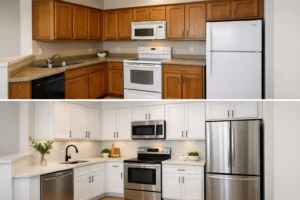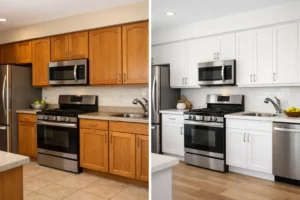
That oak-toned laminate kitchen from the 1980s or 1990s may still have perfectly useful cabinet boxes behind its dated doors. So, can you reface laminate cabinets? In many cases, yes. The deciding factor is not whether the surface looks tired. It is whether the cabinetry underneath is sound enough to deserve a second life.
For homeowners who like their kitchen’s footprint, cabinet refacing can deliver the visual impact of a major renovation without removing cabinetry that is still doing its job. New doors, drawer fronts, finished cabinet faces, updated hardware, and thoughtful adjustments can make the room feel entirely different in a matter of days.
Kitchen Facelift is your planning expert if you live in the Greater Hamilton Area.
Click to see the map for the area (Oakville to Kitchener/Cambridge and north to Milton).
Can You Reface Laminate Cabinets? It Depends on the Boxes
Laminate cabinets are often built with durable particleboard, plywood, or MDF cabinet boxes covered in a laminate or melamine surface. They are common in established homes throughout the Golden Horseshoe, and many have held up remarkably well over decades of family life.
A professional refacing project does not simply cover up problems. It starts by assessing what is there. Strong, level cabinet boxes with secure joints and functioning interiors are excellent candidates. The visible surfaces can be refreshed while the core structure remains in place.
The cabinets may not be suitable for refacing if there is extensive swelling from water damage, crumbling particleboard, major warping, persistent moisture issues, or boxes that have pulled apart at the joints. A loose hinge can be repaired. A damaged cabinet face can often be addressed. But widespread structural failure calls for a different plan.
This distinction matters because refacing is meant to be a lasting improvement, not a cosmetic shortcut. A good consultation should give you a clear answer about the condition of your cabinetry and the work required to achieve the result you want.
What Cabinet Refacing Actually Changes
Many homeowners use the words “refacing” and “painting” interchangeably, but they are very different approaches.
Painting laminate cabinets changes the existing doors and faces. It can be appropriate in certain situations, but laminate must be carefully prepared for paint adhesion, and the result depends heavily on the condition of the original surfaces. Worn edges, peeling thermofoil, damaged door profiles, and aging hardware locations remain part of the equation.
Cabinet refacing replaces the parts you see and touch every day. Typically, that includes custom-fit cabinet doors and drawer fronts, plus a coordinated finish on the exposed cabinet frames, end panels, and other visible areas. You can also select new hardware and make practical upgrades, such as converting a door cabinet to drawers where the cabinet structure allows.
The result is not a coat of color over an old kitchen. It is a new exterior built around the cabinetry that already works.
Doors, drawer fronts, and visible surfaces
The doors and drawer fronts carry most of a kitchen’s visual weight. Replacing them gives you the opportunity to move from dated raised-panel doors to a clean shaker style, a contemporary slab profile, or another look that suits your home.
Matching the new fronts with professionally finished cabinet faces creates continuity. This is especially important around appliance openings, exposed side panels, islands, and tall pantry cabinets, where an incomplete finish can make an update feel pieced together.
Hardware and function upgrades
New handles and pulls are a small detail with a large effect. They can reinforce a traditional, transitional, or modern look while making everyday use more comfortable.
Refacing is also a chance to look beyond appearance. Perhaps a base cabinet is difficult to access and would serve you better with drawers. Perhaps a new appliance requires a cabinet adjustment. Perhaps you want to remove an old backsplash before installing quartz. These changes can often be planned alongside the refacing work, without turning a kitchen refresh into a full demolition project.
The Conditions That Make Refacing a Smart Choice
Refacing tends to make the most sense when you are happy with the location of your sink, appliances, and main work zones. If the layout already supports how your household cooks, gathers, and stores essentials, preserving it is often the intelligent move.
It is particularly well suited to homeowners who have invested in countertops they want to keep. Granite and quartz can be difficult, disruptive, and unnecessary to remove when the cabinet boxes beneath remain solid. A careful refacing plan works around those investments and updates the cabinetry to complement them.
The same is true when timing matters. A full renovation can involve multiple trades, extensive demolition, and a kitchen that is out of commission for weeks. With a properly assessed refacing project, the transformation is commonly completed in two to three days. There is still real craftsmanship and precise installation involved, but the disruption is far more contained.
Refacing may not be the right route if you need to move walls, relocate plumbing, dramatically change the kitchen layout, or correct a fundamentally poor floor plan. Those projects can require more extensive renovation work. There is value in being honest about that from the beginning.
Why Laminate Cabinet Assessment Matters
Not all laminate cabinets age in the same way. Some have durable, intact surfaces with only cosmetic wear. Others may show peeling edges, heat damage near the range, loose hinges, or swollen material under the sink. A photograph can provide an initial sense of the opportunity, but an in-home measurement and inspection are where the details become clear.
An experienced installer will look at cabinet box stability, door and drawer alignment, water exposure, the condition of visible end panels, countertop overhangs, and the fit around appliances. They will also consider whether your desired door style, finish, and hardware require adjustments to the existing boxes.
This level of planning protects the finished result. Custom doors that are measured precisely, aligned properly, and installed on sound cabinetry feel solid from the first close of the hinge. That is the difference between a kitchen that merely photographs well and one that continues to work beautifully through everyday life.
A Clearer, Lower-Disruption Process
For many homeowners, the worry is not just choosing a new door style. It is wondering how much of their home will be disrupted in the process. A focused refacing project is designed to answer that concern.
The process should begin with straightforward guidance, including ballpark pricing based on photos and an early conversation about your goals. Once the project moves forward, an in-home visit allows for physical finish samples, precise measurements, and a closer look at the cabinet condition. This is when practical details, such as a drawer conversion or preparation for a new countertop, can be discussed properly.
After the custom components are made, installation is planned to minimize unnecessary demolition. The team removes only what needs to be removed, protects the surrounding space, and focuses on a clean, precise fit. At Kitchen Facelift, that approach is central to the work: preserve what is functional, transform what you see, and respect the fact that this is your home while the work is underway.
Choosing the Right Finish for a Lasting Update
A fresh kitchen does not have to be stark or trend-driven. The best finish is one that works with your flooring, countertop, wall color, and the amount of natural light in the room.
Warm whites can brighten a traditional kitchen without making it feel cold. Natural wood-look finishes add depth and softness. Deep blue, green, or charcoal can create a more tailored look, especially on an island or lower cabinets. The right choice depends on the surrounding materials and how you want the room to feel at breakfast on a busy weekday, not just in a sample display.
Bring a few photos of your kitchen, along with any countertop or flooring samples you have, to the conversation. Seeing finishes in the actual light of your home helps turn a good idea into a decision you can feel confident about.
If your laminate cabinet boxes are solid, their age is not a reason to discard them. It may be the reason to look at them more closely: a well-built foundation can be the beginning of a kitchen you are genuinely excited to come home to.