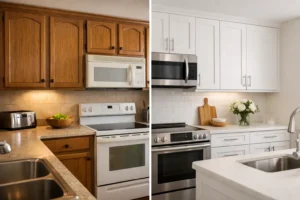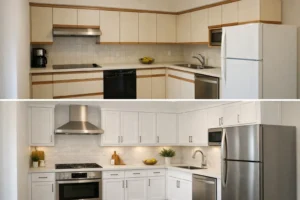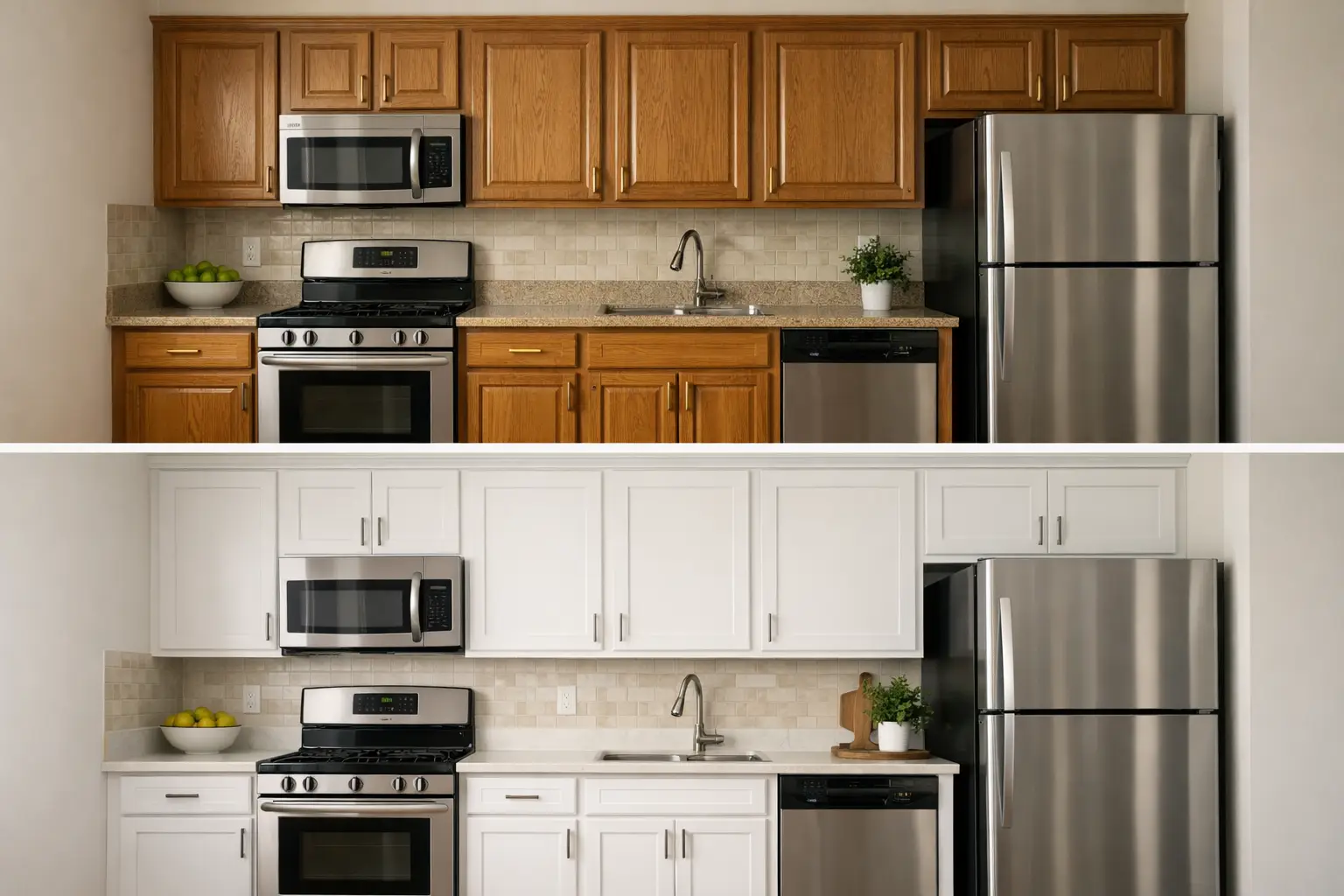
If your kitchen boxes are still solid but the doors make the whole room feel dated, you are not imagining things. For many homeowners, learning how to replace cabinet doors only is the smartest way to get a dramatically different kitchen without tearing out cabinetry that still has years of life left in it.
This approach works especially well in kitchens from the 1980s and 1990s, where the cabinet structure is often sturdier than the style. You keep what still performs well, update what you see every day, and avoid the mess and downtime that come with a full gut renovation. The result can feel surprisingly complete, but only if the details are handled properly.
If you live in the Oakville/Burlington to Kitchener/Cambridge area in Ontario, Kitchen Facelift can take care of you.
When replacing cabinet doors only makes sense
Replacing doors and drawer fronts is a strong option when your cabinet boxes are level, structurally sound, and laid out in a way that still works for your household. If you like your kitchen footprint, have countertops you want to keep, or simply want a cleaner, more current look, this route often delivers exactly what you need.
It is not the right answer for every kitchen. If the boxes are water-damaged, sagging, badly out of square, or poorly installed to begin with, new doors will not solve the underlying problem. The same goes for kitchens with a layout that frustrates you every day. New fronts can improve appearance, but they cannot fix a workflow that never worked.
That is where a little honesty matters. A good cabinet door replacement project should feel like a thoughtful refresh, not a cosmetic cover-up.
How to replace cabinet doors only without costly mistakes
The first step is assessing your existing cabinets with a critical eye. Open every door. Check hinges, shelf stability, drawer function, and the condition of the face frames or cabinet fronts. Look for peeling, swelling around the sink, uneven gaps, and signs that doors have been adjusted repeatedly over the years just to make them close.
If the cabinet bases are in good condition, the next decision is style. This is where the visual transformation happens. A simple shaker door can modernize an older kitchen quickly, while a slimmer profile or flat panel can create a more contemporary feel. The right finish matters just as much. Bright painted tones can freshen a dark kitchen, while warm woodgrain can add softness and depth.
You will also need to decide whether you are replacing only the doors and drawer fronts, or updating the exposed cabinet surfaces as well. In many cases, replacing the fronts alone is not enough. If the old cabinet frames remain in a dated finish, the kitchen can look pieced together. A proper refacing approach usually includes matching or complementary finishing on the visible cabinet boxes so the final look feels intentional.
Measure before you order anything
This is the part that makes or breaks the project. Cabinet doors are not one-size-fits-all, and even small measurement errors can lead to uneven reveals, rubbing doors, and an installation that never looks quite right.
Measure every opening individually. Do not assume matching cabinets are truly identical, especially in older kitchens. Record the height and width of each door and drawer front, note hinge placement, and identify whether you have framed or frameless cabinets. You also need to know the overlay – how much the door overlaps the cabinet opening – because that affects both the look and hardware choice.
Take photos as you go. Label each cabinet clearly. It sounds simple, but it saves confusion later when dozens of similar-looking pieces arrive at once.
Check your hinges and drilling requirements
One of the most overlooked parts of how to replace cabinet doors only is hinge compatibility. Older kitchens may use exposed hinges, partial wrap hinges, or hardware patterns that do not line up with modern concealed hinges. If you are changing hinge style, the doors need to be drilled correctly for the new hardware.
That is one reason custom-fit doors matter. They are built for your exact cabinet configuration, not forced into place with fillers and compromises. If you want soft-close hinges, tighter lines, and a more current appearance, the boring pattern and door thickness need to be right from the start.
What homeowners often underestimate
Replacing cabinet doors sounds straightforward, and in some kitchens it is. But there is a difference between getting new doors attached and getting a finished result that looks polished.
Alignment takes patience. So does adjusting hinges so gaps are even across the entire kitchen. End panels, valances, filler pieces, and exposed sides all need to relate visually to the new fronts. If you skip those transitions, the eye goes straight to the mismatch.
There is also the question of drawer upgrades. Many homeowners start by asking about doors only, then realize the old drawer fronts and worn drawer boxes will stand out once everything else looks new. Sometimes a project stays simple. Sometimes it makes sense to convert a few lower cabinets into deep drawers or replace selected drawer hardware so the kitchen functions better too.
That is the trade-off. The narrower the scope, the lower the disruption. But the more selective the updates, the more carefully they need to be planned so the kitchen still feels cohesive.
DIY or professional installation?
If you are handy, detail-oriented, and comfortable measuring with precision, a DIY cabinet door replacement may be possible in a very simple kitchen. A powder room vanity or laundry room is often a reasonable place to try it.
A full kitchen is different. Doors need to be ordered accurately, finished consistently, installed cleanly, and adjusted across multiple runs of cabinetry. If your kitchen includes custom-sized openings, older cabinet boxes, stone countertops, or any modifications to accommodate appliances, professional help usually pays for itself in avoided frustration.
This is especially true when you want the kitchen to look fully refreshed rather than partly updated. Professional cabinet refacing is not just about hanging new doors. It is about making the visible surfaces, hardware, fit, and finish work together so the room feels new as a whole.
How to replace cabinet doors only and still get a full-kitchen look
The best results come from treating the project like a design decision, not just a parts order. Door style, finish, hardware, and box surfacing should all be chosen together. Even small updates like new handles can shift the kitchen from traditional to transitional or modern.
If you already have granite or quartz countertops, this kind of refresh can be particularly worthwhile. You preserve the investment you have already made while bringing the cabinetry up to the same standard visually. That balance matters. A beautiful countertop deserves cabinet fronts that do not date the room.
For homeowners who want speed and predictability, this approach also has a practical advantage. When the existing layout stays intact and the cabinet structure is reusable, the project timeline becomes much more manageable. That is one reason companies like Kitchen Facelift focus on transforming what works instead of removing it just because it is there.
A few signs it is time to go beyond doors only
Sometimes the right advice is to do a little more. If your cabinet boxes have shifted, if your storage is not serving you, or if your backsplash, trim, or appliance openings need adjustment, a partial remodel may be the better fit. That does not mean a full renovation is necessary. It may simply mean the project should include selective modifications along with new doors and finishes.
That middle ground is where many of the best kitchen updates happen. You keep the bones, improve the function where needed, and avoid unnecessary demolition.
What to expect from the finished result
When done well, replacing cabinet doors only does not look like a shortcut. It looks like a smart decision. The kitchen feels cleaner, lighter, and more current because the surfaces that define the room have changed. Most guests will never ask whether the boxes are original. They will just notice that the kitchen feels updated.
And that is really the point. Not every kitchen needs to be torn apart to feel new. Sometimes the better move is quieter than that – keep the good structure, replace what dates the room, and make sure every visible detail is handled with care.
If you are weighing your options, start with the condition of your cabinets, not just the style of your doors. A good kitchen refresh begins with honesty, and the best one leaves you wondering why anyone would create more disruption than necessary.