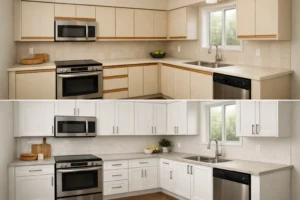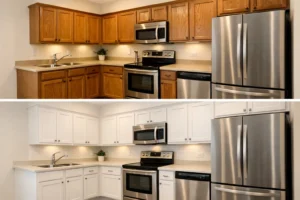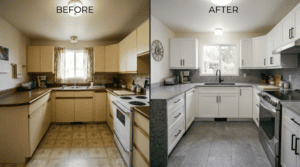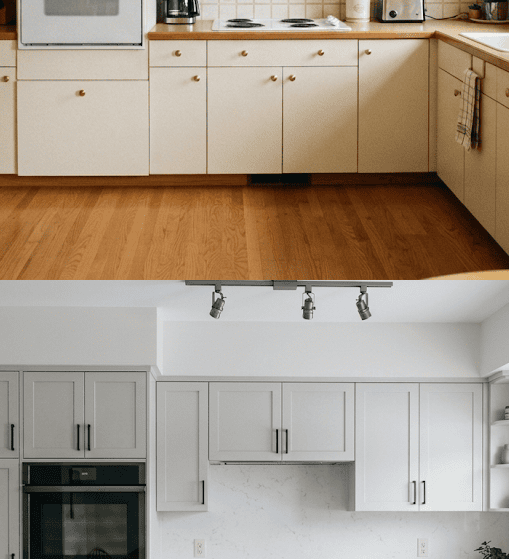
That cabinet beneath your cooktop may be doing very little for you. Reaching into a dark lower cabinet, shifting baking sheets aside, and kneeling to find one pan is the kind of daily frustration that makes a kitchen feel older than it is. The best kitchen drawer conversion ideas solve that problem at its source: they bring the contents of your cabinets forward, into view, and within easy reach.
For many homeowners, converting selected cabinet doors to drawers is one of the most meaningful changes they can make without changing a kitchen’s footprint. When the cabinet boxes are solid and the layout already works, drawers add function where it matters most while preserving the parts of the kitchen that are still worth keeping.
Kitchen Facelift is your planning expert if you live in the Greater Hamilton Area.
Click to see the map for the area (Oakville to Hamilton to Niagara and north to Milton).
Why convert cabinet doors to drawers?
Drawers make better use of lower cabinetry because they pull out fully. Instead of storing items in layers and hoping you remember what is at the back, you can see the entire drawer at once. That is especially useful for heavy cookware, food storage containers, small appliances, and the everyday items that otherwise collect in deep base cabinets.
The right conversion also makes a kitchen more comfortable to use. You spend less time bending, reaching, and moving one item to get to another. For busy households, that is not a minor detail. It is the difference between a kitchen that looks refreshed and one that genuinely feels easier every day.
Still, not every cabinet should become a drawer bank. A cabinet holding a sink, plumbing, or a large appliance may need a different approach. The strongest plan starts with how you actually cook, clean, and put groceries away.
10 best kitchen drawer conversion ideas for better flow
1. Deep drawers for pots, pans, and lids
Replacing a standard lower cabinet with two deep drawers is often the most satisfying conversion. The top drawer can hold lids, utensils, or shallow cookware, while the deeper lower drawer handles pots, Dutch ovens, and frying pans. Full-extension hardware matters here. A drawer that opens all the way lets you see every piece without unloading the front first.
This is an excellent choice near the range or cooktop, where heavy cookware belongs within arm’s reach. It also helps protect both your back and your patience on a weeknight.
2. Wide drawers beneath a cooktop
If there is a suitable cabinet beneath your cooktop, wide drawers can create a highly efficient cooking zone. Keep frequently used pans in the bottom drawer and oils, spices, or cooking tools in the upper drawer, provided clearances and appliance requirements allow it.
This conversion needs careful professional assessment. Cooktop specifications, heat clearances, and the cabinet’s construction all affect what is possible. When done correctly, it gives the busiest part of the kitchen a calmer, more intentional rhythm.
3. Pullout drawers for pantry staples
A tall pantry is useful, but lower base cabinets can become an equally valuable food-storage zone with pullout drawers. Deep drawers can hold cans, jars, snacks, baking ingredients, and lunch supplies in clear categories.
Consider adding one or two adjustable dividers rather than over-compartmentalizing every inch. Your grocery habits will change over time, and flexible storage gives the drawer a longer useful life. This option works particularly well when a traditional pantry is limited or located away from the main prep area.
4. A dedicated recycling and waste drawer
A pullout waste and recycling drawer is one of those improvements you notice immediately. It keeps bins out of sight, contains everyday clutter, and places cleanup where it belongs – usually close to the sink or prep space.
The practical details matter. Measure the bins you need, allow room for liners, and think about whether compost is part of your routine. A well-designed drawer should make sorting simple, not create another chore.
5. Drawer banks for food containers
Food storage containers are notoriously awkward in a cabinet. Lids slide behind bowls, mismatched pieces accumulate, and the whole area becomes a small daily annoyance. A medium-depth drawer bank makes it easier to organize containers by size, with lids stored upright in a divider.
Place this conversion near the refrigerator, dishwasher, or kitchen island if that is where leftovers are usually packed. The best storage is not just tidy. It supports the route you already take through the room.
6. A shallow drawer for knives and prep tools
A shallow top drawer fitted with a knife organizer keeps sharp tools protected, accessible, and off the countertop. It is a refined alternative to a block that takes up valuable prep space.
This can also be a home for peelers, measuring spoons, thermometers, and other small tools used every day. Choose an insert that fits the drawer precisely. Loose organizers tend to shift, leaving even a beautiful new drawer feeling unfinished.
7. Vertical drawers for baking sheets and cutting boards
Narrow vertical pullouts are ideal for baking sheets, cooling racks, cutting boards, and serving trays. These items are hard to stack neatly, yet they are too useful to hide in a distant closet.
A slim cabinet beside the range, wall oven, or refrigerator may be a good candidate. The conversion depends on available width and cabinet structure, but even a narrow space can become hardworking storage when planned around the items that fit it.
8. Drawers for small appliances
Toasters, blenders, mixers, and air fryers can crowd a counter quickly. A deep drawer or cabinet conversion can give these appliances a proper home, especially when it is located near an outlet and the place where you use them.
Be realistic about size and weight. A stand mixer needs sturdy hardware and enough vertical clearance. Appliances should also be removed from the drawer before operating unless the space has been specifically designed and approved for that purpose.
9. An island drawer conversion
The kitchen island is often the hardest-working surface in the room, but its storage can be surprisingly underused. Converting island doors to drawers gives you a natural place for serving ware, table linens, kids’ snacks, mixing bowls, or entertaining supplies.
Think about which side of the island makes sense. The kitchen-facing side may serve prep and cooking, while the seating side can store items you want available without interrupting the person cooking. This is a small planning decision with a noticeable effect on traffic flow.
10. Hidden drawers inside deep drawers
For a more tailored result, add a concealed inner drawer within a larger drawer. The shallow inner level is excellent for utensils, wraps, bag clips, or tea towels, while the deeper space below remains available for bulkier items.
This approach gives you layered storage without adding visual clutter to the cabinetry. It is particularly effective in kitchens where homeowners want a clean, modern exterior while keeping every practical detail close at hand.
Plan a drawer conversion around real life
Before choosing a style, spend a few days noticing where frustration happens. Which cabinet is avoided because it is too hard to access? What is always left on the counter because there is no convenient home for it? Those answers are more useful than a generic storage plan.
Then consider the cabinet itself. Solid existing boxes can often be an excellent foundation for new drawer systems, but measurements, frame construction, plumbing, appliance clearances, and countertop conditions need professional review. A conversion must fit precisely, operate smoothly, and look as though it was always part of the kitchen.
Finish matters, too. New drawer fronts should relate naturally to the surrounding doors, hardware, and countertop. If you are already considering cabinet refacing, door-to-drawer conversions can be incorporated into the same transformation. At Kitchen Facelift, this is assessed as part of a custom plan, so the functional improvements and the finished look work together rather than feeling added on.
For homeowners who love their current layout, this is often the smart middle ground. You can preserve solid cabinetry and avoid unnecessary demolition while improving the parts of the kitchen that affect your routine most.
A great drawer conversion should not ask you to change how you live in your kitchen. It should make the kitchen feel like it finally understands how you live there.