Kitchen Facelift is your planning expert if you live in the Greater Hamilton Area.
Click to see the map for the area (Oakville to Hamilton to Niagara and north to Milton).
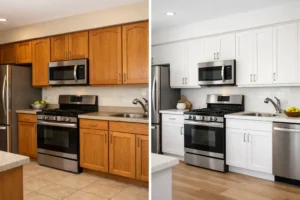
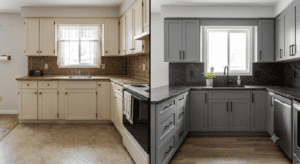
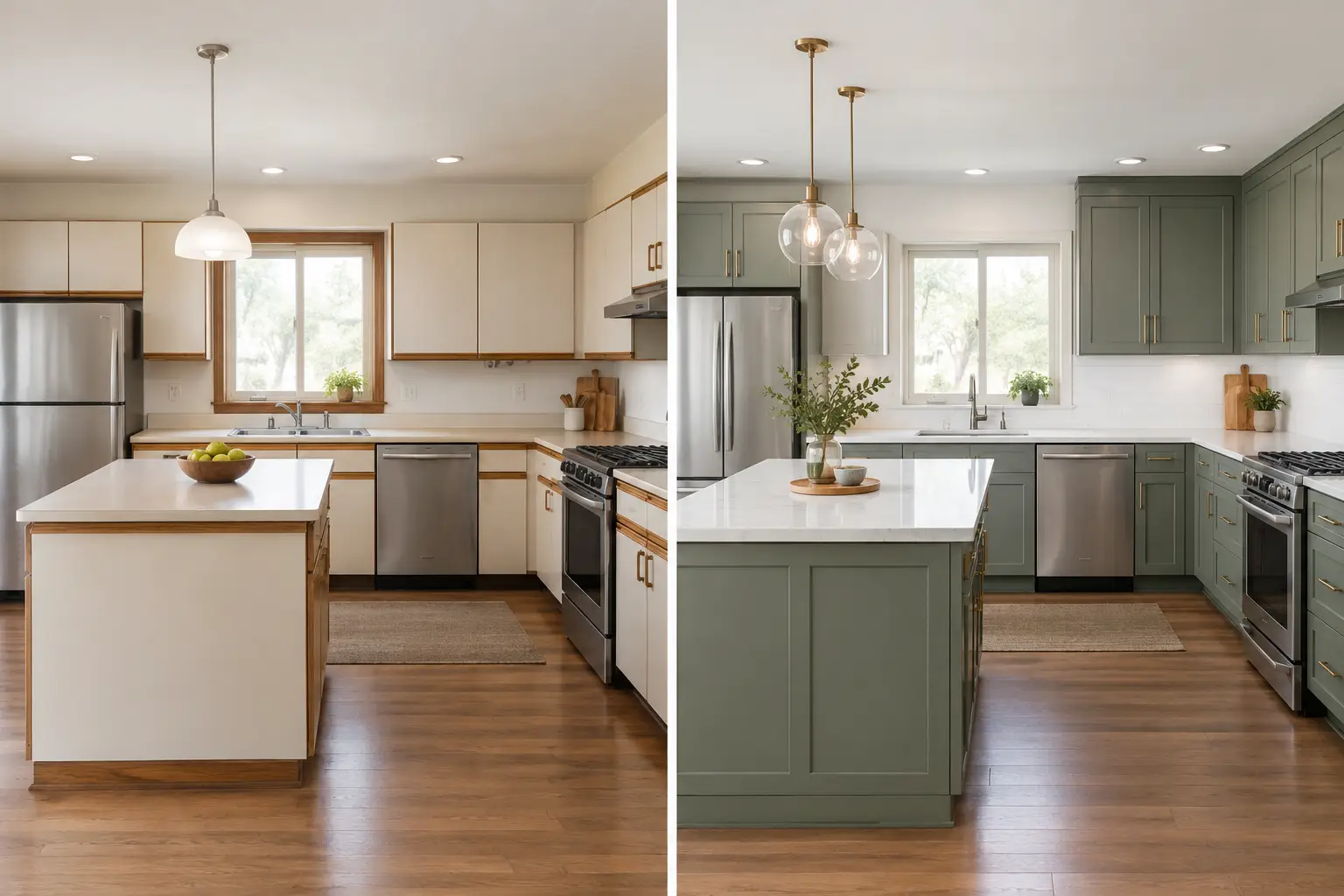
When your kitchen still works but no longer feels like you, the decision often comes down to custom doors versus refinishing. Both can change the look of existing cabinetry without rebuilding the entire room. The better choice depends on what you want to preserve, how much change you are after, and how you want the finished kitchen to perform over time.
For many homeowners with solid 1980s and 1990s cabinet boxes, the answer is not a full renovation. It is a thoughtful transformation that respects the parts of the kitchen that are still doing their job.
Custom Doors Versus Refinishing: The Real Difference
Refinishing keeps your existing cabinet doors and drawer fronts. Depending on the project, that may involve cleaning, sanding, repairing, priming, and applying a new painted finish or stain. The profile, construction, and proportions of the doors remain largely the same.
Custom doors replace the visible fronts of the kitchen while the existing cabinet boxes stay in place, provided they are structurally sound and well positioned. New doors and drawer fronts are made to fit your cabinetry precisely, then professionally installed with updated hardware and finishing details.
That distinction matters. Refinishing changes the surface. Custom doors can change the surface, style, proportions, function, and overall character of the kitchen.
When Refinishing Can Be the Right Choice
Refinishing can make sense when you genuinely like your current door style and the doors are in excellent condition. A simple, flat-panel door with a sound finish may respond well to a carefully executed painted update. It can also be a reasonable choice when your goal is a limited visual adjustment rather than a meaningful redesign.
The condition of the existing doors is the deciding factor. Wood movement, peeling coatings, worn edges, previous repairs, and deep grain can all affect how smooth and consistent a refinished result will look. Detailed door profiles may also hold onto their dated appearance even after the color changes.
There is also the practical side. Refinishing requires significant preparation, and the work often happens around the existing kitchen. That can mean more masking, drying time, odors, and care around appliances, countertops, and nearby living areas. A quality result is possible, but it is highly dependent on the starting condition of every door and drawer front.
Why Custom Doors Create a Bigger Transformation
Custom doors are often the better fit when homeowners love their kitchen layout but want the room to feel entirely current. You are not limited to the old door shape. You can move from raised-panel doors to a clean Shaker style, choose a modern slab door, introduce a warm wood-look finish, or create a softer transitional design that suits the rest of your home.
Because the doors and drawer fronts are built specifically for your cabinets, the result feels intentional rather than applied. New hinges, handles, and drawer fronts complete the change. The kitchen can look redesigned without removing cabinet boxes that are still sturdy and useful.
This approach also opens the door to practical improvements. A cabinet can be converted to drawers where the layout allows. End panels can be refreshed. Areas around new appliances can be adjusted. If you are planning quartz countertops, the cabinetry can be prepared so the whole kitchen comes together cleanly.
For homeowners who have already invested in granite or quartz, this is especially valuable. Preserving the existing footprint and working carefully around the countertop protects what is already worth keeping.
Design Freedom Matters More Than Most People Expect
Color gets attention, but door style changes the feeling of the room just as much. A new white finish on an old raised-panel door may brighten the kitchen, yet it will still read as the same era. Replacing that door with a contemporary, custom-fit profile changes the lines you see from every angle.
Custom doors also allow for a more coordinated plan. You can choose the door style, finish, hardware, and drawer configuration together rather than asking a new paint color to solve every design issue on its own.
Durability Is About More Than the Finish
A refinished door can look beautiful, particularly when the substrate is stable and preparation is thorough. Still, it remains an older component with its original construction, joints, edges, and wear points. If the door has been opened, cleaned, bumped, and exposed to kitchen humidity for decades, a new coating cannot erase every limitation underneath.
With custom doors, you begin with new materials and a finish selected for a kitchen environment. The quality of the product and installation both matter, which is why a proper assessment should come before any recommendation. Cabinet refacing is not about covering problems. It is about retaining solid cabinet boxes and renewing the parts that have the greatest visual and daily impact.
The right professional will tell you when a cabinet box needs attention, when a door can reasonably be retained, and when a different approach would serve you better. That clarity is more valuable than a one-size-fits-all answer.
Timing, Mess, and Life at Home
A kitchen project is not just a design decision. It affects meals, routines, pets, work-from-home schedules, and everyone else using the house.
Refinishing may sound straightforward because fewer components are replaced, but the preparation and curing process can make the experience more involved than expected. Surfaces must be protected, doors may need to be worked on in place or removed, and the space needs time to be ready for normal use.
A professionally planned refacing project is different. Once measurements, materials, and selections are finalized, much of the work has already been organized before installation day. Custom-fit doors and drawer fronts arrive ready for the transformation. In many cases, a kitchen facelift can be completed in two to three days, with only the demolition and adjustment work that is truly necessary.
That is a meaningful advantage for busy households. You get a substantial visual change without turning your home into a long-term construction zone.
How to Decide What Your Kitchen Needs
Start by looking past the finish. Ask yourself whether you like the actual shape and style of your cabinet doors. If the answer is yes, refinishing may deserve consideration. If your answer is, “I want it to look like a different kitchen,” custom doors will usually offer the more satisfying path.
Then assess the cabinet boxes honestly. Are they solid, level, and functional? Do you like the current layout? Are your countertops worth preserving? If so, refacing with custom doors can be an intelligent investment because it focuses resources on the parts that need to change.
It also helps to think about daily function. Would deeper drawers make cooking easier? Are there appliances you want to update? Does the kitchen need a cleaner transition to a new backsplash or countertop? These are the details that turn a cosmetic update into a kitchen that works better for your life.
A Consultation Should Make the Choice Clearer
You should not have to guess whether your cabinetry is a candidate for refinishing or refacing. A good consultation begins with photos and a practical conversation about your goals, followed by an in-home review when the project is a fit. Seeing physical door samples in your own lighting and taking precise measurements removes much of the uncertainty.
The goal is not to push you toward the largest project. It is to help you choose the approach that gives you the look, longevity, and level of disruption you are comfortable with.
If your cabinet boxes are solid but the kitchen no longer reflects your home, do not assume replacement is the only meaningful change available. Start with a few photos, a clear idea of what is no longer working, and a cup of your favorite beverage. The right plan often becomes obvious once you can see what is worth keeping.