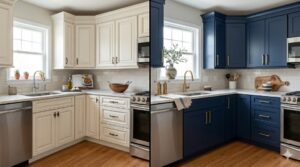
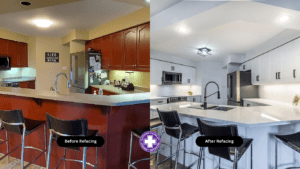
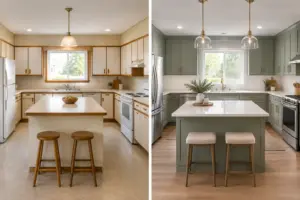
Kitchen Facelift is your planning expert if you live in the Greater Hamilton Area. Choosing cabinet finishes becomes much easier when you can see how each option will live in your home.
Click to see the map for the area (Oakville to Hamilton to Niagara and north to Milton).
A cabinet finish can look perfect on a sample door, then feel completely different beside your existing quartz, hardwood floors, and afternoon light. That is why the best choice is rarely just the color you liked online. It is the finish that suits your kitchen’s fixed elements, your daily routines, and the kind of home you want to walk into every day.
For homeowners who like their kitchen layout but are ready for a meaningful change, cabinet refacing creates room to make that choice carefully. New custom-fit doors and drawer fronts can give solid existing cabinetry a fresh, current look without turning the entire home upside down.
Start Choosing Cabinet Finishes With What Stays
Before looking at door colors, identify what is not changing. Countertops, flooring, backsplash, wall paint, appliances, and natural light all influence how a finish reads. A warm white cabinet can appear creamy beside cool gray quartz. A soft greige may look distinctly taupe against honey-toned floors.
Countertops deserve particular attention because they sit directly against the cabinetry. If you have invested in granite or quartz you still love, bring a sample or clear photo into the decision. The goal is not necessarily to match every undertone. It is to create an intentional relationship between the surfaces.
Look at your kitchen at more than one time of day, too. North-facing rooms often need a finish with warmth, while bright south-facing kitchens can carry cooler tones beautifully. The physical samples used during an in-home consultation matter here. A screen cannot show how your own lighting changes a finish from morning to evening.
Choose a Color That Supports the Room
White remains popular for good reason. It reflects light, makes a compact kitchen feel open, and works across many home styles. But white is not one simple decision. Some whites are crisp and cool; others carry a subtle warmth that feels softer alongside wood flooring and traditional trim.
Greige, mushroom, light taupe, and gentle gray can offer more depth while staying calm and versatile. These shades work especially well in established homes where you want a modernized kitchen that still feels connected to the rest of the house. They are often forgiving of everyday fingerprints compared with a very bright white, although the exact door profile and sheen also make a difference.
Darker finishes bring contrast and a tailored feel. Deep blue, charcoal, and rich wood tones can ground a large kitchen or make an island feel like a focal point. In a smaller or lower-light room, however, using a dark finish everywhere may make the space feel more enclosed. A two-tone design can be the right middle ground: lighter perimeter cabinets with a darker island or lower cabinets.
The safest choice is not automatically the palest or most neutral one. It is the one that makes the room feel balanced and feels true to your home. If you are preparing to sell, a broadly appealing palette may make sense. If you plan to stay, prioritize the finish you will be happy to see through ordinary Tuesday mornings and busy family dinners.
The Finish Is More Than the Color
When people talk about cabinet finishes, they often mean color. The surface treatment matters just as much. It affects how the doors reflect light, how easily they clean, and how the kitchen holds up to real life.
A matte or low-sheen finish has a soft, contemporary appearance and can minimize the look of smudges and minor surface marks. It is a strong option for homeowners who prefer an understated, refined kitchen. A higher sheen reflects more light and can make colors appear sharper, but it may show fingerprints more readily, especially on darker doors.
Woodgrain finishes add texture and warmth without requiring a fully traditional design. They can look especially at home in kitchens with stone countertops, black accents, or wide-plank flooring. The key is to consider the grain direction and scale. A subtle, linear grain often feels clean and current, while a more pronounced pattern makes a stronger design statement.
Whatever direction you choose, ask to see full-size samples rather than relying on a small chip. A finish can have undertones, texture, and movement that become visible only across a larger surface.
Durability Should Match Daily Life
A busy kitchen needs a finish that is meant to be used, not admired from a distance. Families with young children, enthusiastic cooks, and frequent entertainers should think about the areas that receive the most contact: cabinet doors near the sink, drawer fronts, pantry pulls, and the island.
Premium cabinet components are designed for regular cleaning and everyday use, but no finish is completely maintenance-free. Dark, flat surfaces may show grease marks near the cooktop. Highly textured finishes can collect residue in their grain if they are not wiped regularly. Very light doors can reveal splashes from coffee, tomato sauce, or cooking oils sooner than mid-tone finishes.
That does not mean avoiding the finish you love. It means choosing with clear expectations. A finish that fits your habits will continue to feel like a good decision long after installation day.
Match the Door Style to the Finish
Door style and finish should work as a pair. A sleek slab door emphasizes the color and texture of the surface. It suits simple, modern kitchens and makes a strong case for woodgrain, warm neutrals, or a clean painted look.
Shaker-style doors are remarkably flexible. They can look classic in a warm white, transitional in a soft gray, or more contemporary in a deep, confident tone. Their framed detail adds just enough structure to keep a quiet finish from feeling plain.
More detailed door profiles can bring character to a traditional home, but they usually benefit from a finish that does not compete with every line and shadow. If the door has visual detail, a calm, considered color often creates the most polished result.
Hardware completes the picture. Brushed nickel, matte black, warm brass, and integrated pulls each shift the personality of the same cabinet finish. Hold hardware against the sample before committing. The difference between “almost right” and truly cohesive is often found in that final pairing.
Think Beyond Today’s Trend
Trends can be helpful for identifying what you respond to, but they should not make the decision for you. Cabinet doors are a significant visual surface, and a kitchen should still feel good after the most photographed color of the year has moved on.
A practical approach is to use enduring finishes for the larger areas and introduce personality through elements that are easier to update. Hardware, lighting, stools, paint, and décor can evolve over time. Your cabinetry can remain the confident backdrop.
That said, timeless does not have to mean cautious. A deep island, a warm woodgrain pantry wall, or a distinctive finish on a media center can add character without overwhelming the room. The right amount of contrast depends on your architecture, light, and comfort with change.
See the Whole Plan Before You Decide
Cabinet finishes should be selected alongside the details that will shape the finished kitchen: new backsplash, countertop plans, appliance changes, crown molding, lighting, and any conversion from doors to drawers. One decision influences the next.
This is where a guided, in-home review is especially valuable. You can compare physical door samples beside your existing materials, talk through the practical trade-offs, and see which options fit both your vision and the project scope. It replaces guesswork with a decision you can feel settled about.
For many homeowners, the best finish is not the boldest sample or the most familiar choice. It is the one that makes the whole kitchen feel finished, personal, and easy to live with. Take your time with the samples, grab a cup of your favorite beverage, and picture the room as it will serve your life – not just how it will photograph.