A kitchen can feel dated long before it stops working. If your cabinet boxes are solid, your layout serves your family, and you are tired of the doors, finishes, or drawer fronts you see every day, refacing vs replacing cabinets is not a small decision. It is the difference between improving what already works and starting your kitchen over from the inside out.
For many homeowners, the best answer is not automatically a full replacement. It depends on the condition of your cabinetry, the changes you want to make, and how much disruption makes sense for your home.
Kitchen Facelift is your planning expert if you live in the Greater Hamilton Area.
Click to see the map for the area (Oakville to Kitchener/Cambridge and north to Milton).
What Cabinet Refacing Actually Changes
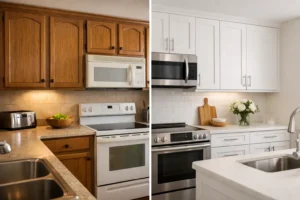
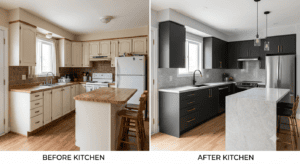
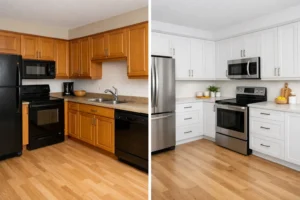
Cabinet refacing preserves the existing cabinet boxes while transforming the visible parts of the kitchen. New custom-fit doors and drawer fronts are installed, the exterior of the cabinet frames is finished to match, and new hardware completes the look. The result can be a dramatic change in style without removing sound cabinetry that still has years of life ahead.
This is especially appealing in homes with well-built kitchens from the 1980s and 1990s. Many of those cabinet boxes were made to last. They may be visually tired, but they are often structurally stronger than homeowners realize.
A thoughtful refacing project can also include practical adjustments. You may convert a door cabinet to drawers, remove a backsplash, make room for a new appliance, or prepare the space for quartz countertops. The goal is not to preserve every detail at all costs. It is to keep what is working and change what will make the kitchen function and feel better.
At Kitchen Facelift, doors, drawer fronts, and finishes are custom-made in Canada for the kitchen in front of us. That tailored fit matters. A refaced kitchen should look intentional, not like a surface-level update.
When Refacing Is the Smarter Choice
Refacing tends to make sense when your kitchen has a good footprint. You know where the dishes belong, traffic flows well, and the sink, appliances, and prep areas are where you want them. What you want is a cleaner, more current kitchen that better reflects your home now.
It can be an especially wise choice if you have already invested in granite or quartz countertops. Removing cabinet boxes beneath existing stone can create added complexity and risk. Refacing lets you update the cabinetry around the countertop you already love, often with far less upheaval.
Timing is another meaningful advantage. A full cabinet replacement can trigger a chain of work: demolition, electrical adjustments, plumbing changes, drywall repair, flooring decisions, countertop templating, and multiple trades moving through your home. Refacing is more contained. Most Kitchen Facelift transformations are completed in two to three days, giving busy households a clear path to a finished kitchen without turning daily life upside down.
There is also the matter of waste. If cabinet boxes are stable and functional, sending them to disposal simply because the doors are dated does not always feel like the right use of your renovation budget or materials. Refacing is a considered choice that respects the good bones already in your home.
When Replacing Cabinets Makes More Sense
Cabinet replacement is the right call when the cabinet boxes themselves have reached the end of their useful life. Persistent water damage, swollen particleboard, broken structural components, severe wear, or boxes that no longer hold securely can make refacing a poor long-term investment.
Replacement also deserves serious consideration when the layout is the problem. Perhaps you need to move the sink, create a larger island, open a wall, improve a cramped work area, or change the location of major appliances. Those are structural design decisions, not cosmetic ones. New cabinets give you the freedom to rethink the room from the ground up.
Some kitchens have storage issues that go beyond a few smart modifications. If the room lacks enough cabinetry altogether, has unusable corners, or cannot support the way your family cooks and gathers, a full redesign may provide the better outcome.
That does not mean replacement is automatically more premium or more appropriate. It simply solves a different problem. If your layout and cabinet boxes are sound, replacing everything can add disruption without improving the parts of your kitchen that truly need attention.
Refacing vs Replacing Cabinets: The Real Trade-Offs
The clearest way to compare refacing vs replacing cabinets is to look beyond the finished photograph. Both can create a beautiful kitchen. The better choice is the one that aligns with your home, priorities, and appetite for renovation.
Cost and value
Refacing generally requires less labour and fewer materials than removing and rebuilding an entire cabinet system. That can leave more room in your overall plan for details that make a daily difference, such as new hardware, drawer conversions, a backsplash, lighting, or countertops.
Replacement can be worthwhile when it corrects layout failures or damaged cabinetry. But if you are replacing perfectly functional boxes solely to change their appearance, you may be paying for demolition and reconstruction that do not improve how your kitchen works.
Timeline and disruption
A cabinet replacement project often affects several surfaces and systems at once. Even with careful planning, your kitchen may be out of commission for an extended period. Refacing is designed for homeowners who want a significant visual transformation while keeping the project focused and manageable.
For a family coordinating work, school, meals, and everyday routines, the difference between days and weeks can be substantial. Less demolition also means less dust, fewer moving parts, and fewer decisions that can appear once walls and cabinets are removed.
Design flexibility
Replacement offers the broadest freedom. If you want to relocate everything, change the footprint, or build a kitchen that functions in a completely different way, it is the natural route.
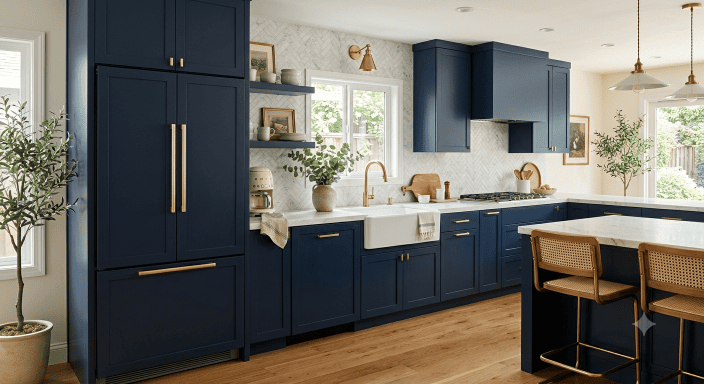
Refacing has its own flexibility within the existing layout. Door styles, finishes, hardware, and drawer configurations can shift the personality of a kitchen from traditional to contemporary, warm to crisp, or understated to striking. It is not a compromise when the existing plan is already right. It is a focused transformation.
Long-term confidence
The quality of the assessment matters as much as the project type. A reputable professional should look honestly at box condition, hinges, drawer function, countertop considerations, appliance clearances, and the changes you hope to make. Refacing should never be recommended for cabinetry that cannot support it well.
Likewise, replacement should not be presented as the only path when a kitchen’s foundation is still strong. Good advice begins with the actual condition of your home, not a one-size-fits-all answer.
A Simple Way to Decide
Start by asking one question: is the problem your kitchen’s structure, or is it what you see and how a few areas function?
If the cabinet boxes are solid and you like the layout, refacing is likely worth exploring first. Take note of any targeted improvements that would make the kitchen work harder for you, such as deeper drawers, a better pantry configuration, or space for a new range.
If you dislike the room’s flow, need to move major services, or have damaged cabinetry, replacement may give you the foundation you need. Be honest about the scope, too. A project that changes the layout usually extends beyond cabinets alone.
The best next step is a professional assessment with clear numbers and realistic expectations. Photos can often establish a useful ballpark early, followed by an in-home visit to review samples, measurements, and the details that matter in your particular kitchen.
Your kitchen does not need to be torn apart to feel entirely new. When the structure is sound, keeping it can be one of the most intelligent decisions you make – leaving you with a space that looks beautifully renewed and a renovation experience that still feels like your home.