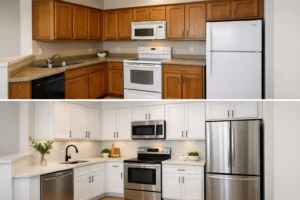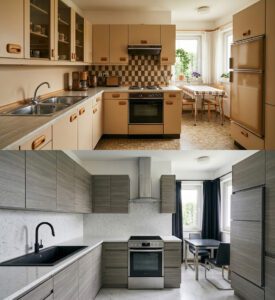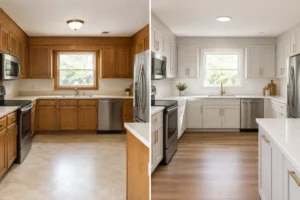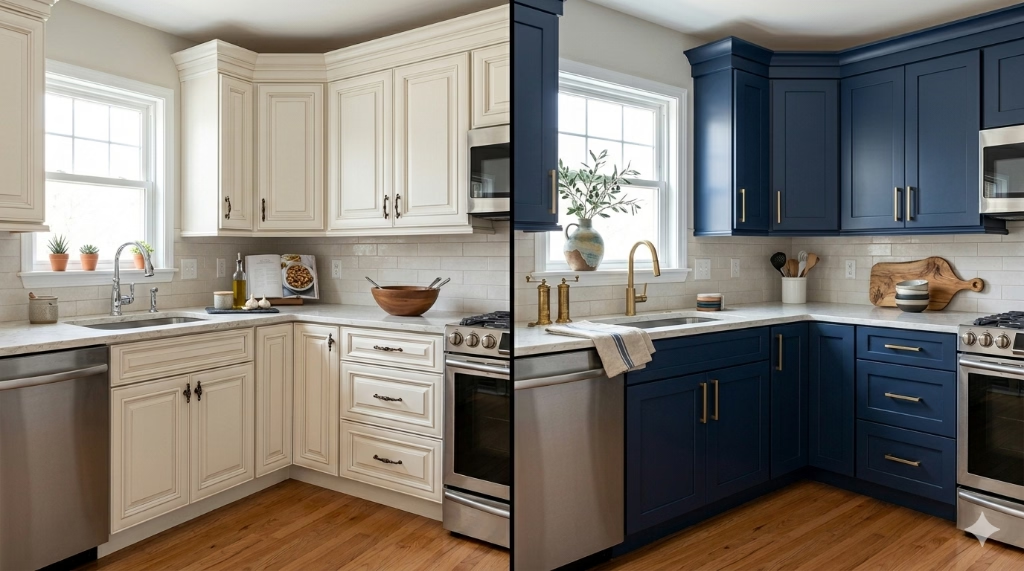
Your quartz countertop may be the most valuable surface in your kitchen – and one of the best reasons to choose cabinet refacing carefully. The right team can protect quartz during refacing while giving the cabinetry beneath it a dramatic new look. The wrong approach can turn a straightforward update into an avoidable countertop repair.
For homeowners who love their kitchen layout and their existing stone, refacing offers a practical path forward. You can replace dated doors, drawer fronts, visible cabinet surfaces, and hardware without removing functional cabinet boxes or disturbing the quartz unnecessarily. The key is treating the countertop as a fixed, finished part of the room from the first measurement through final cleanup.
Kitchen Facelift is your planning expert if you live in the Greater Hamilton Area.
Click to see the map for the area (Oakville to Hamilton to Niagara and north to Milton).
Why quartz needs special care during refacing
Quartz is durable, but it is not indestructible. Its surface holds up beautifully to everyday kitchen life, yet its edges, corners, seams, and cutouts deserve protection during any cabinetry work. A dropped tool, a cabinet component leaned against an exposed edge, or too much movement beneath the counter can create a chip, crack, or stress point.
The risk is not usually the new doors themselves. It is the work around them: removing old doors and drawer fronts, fitting new end panels, adjusting fillers, changing a door bank into drawers, or accommodating a new appliance. Good refacing is precise work. When quartz is staying in place, that precision matters even more.
A professional assessment should confirm that the existing cabinet boxes are sound, level, and appropriate to retain. Refacing is designed to preserve what works. If a cabinet base is compromised or a major layout change is planned, the conversation changes because the countertop may need to be removed or replaced. Honest advice up front protects both your investment and your expectations.
Protect quartz during refacing with planning, not luck
The safest installation begins before anyone arrives with tools. Measurements must account for the countertop overhang, thickness, edge profile, seams, sink cutout, and the relationship between the quartz and every cabinet face below it. This allows new components to be made to fit the kitchen rather than forcing changes on installation day.
Start with a clear scope of work
Refacing can be wonderfully efficient when the kitchen footprint remains largely intact. New custom doors and drawer fronts, fresh finishes, decorative panels, and updated hardware can completely change the room without moving the stone.
However, some requests require closer planning. Converting a door cabinet to drawers may involve interior modifications. Replacing a dishwasher can affect surrounding panels and clearances. A new range or refrigerator may call for adjustments to tall cabinets or fillers. Removing a backsplash is possible in many kitchens, but it must be approached with care because it meets the countertop along a visible and potentially vulnerable line.
A good contractor will explain what can be refreshed while the quartz remains undisturbed and what may introduce added risk. That is not hesitation. It is respect for the materials already in your home.
Keep cabinet boxes stable beneath the countertop
Quartz countertops rely on a properly supported, level base. During cabinet refacing, the goal is generally to leave those supporting cabinet boxes in place. Pulling out base cabinets, shifting them, or making broad structural changes under an installed countertop can place stress on the stone, especially around seams and cutouts.
Small, controlled adjustments are different from moving an entire run of cabinetry. Experienced installers work methodically, checking clearances and fastening new materials without using the countertop as a brace, work surface, or place to rest heavy components. If leveling or structural corrections are needed, they should be assessed before work begins, not discovered after the project is underway.
Protect the surface, edges, and sink area
Before installation starts, the quartz should be clean and free of loose items. Countertop protection can then be placed where work will occur, with special attention to exposed edges, corners, and the area around the sink. Protection should be secure, non-abrasive, and removed carefully at the end of the job.
The sink cutout deserves particular attention. The narrow sections of quartz in front of and behind an undermount sink are not a place to lean, sit, clamp, or stage materials. The same goes for unsupported countertop overhangs, such as a peninsula seating area. A careful crew plans its staging area elsewhere.
It also helps to clear a route from the entry door to the kitchen. Removing rugs, small furniture, and decorative items gives installers room to carry custom components safely without navigating obstacles beside your countertop.
What homeowners can do before installation day
You do not need to turn your kitchen into a construction site to prepare well. A few simple steps make the process smoother and help protect the quartz during refacing.
Empty the cabinets and drawers being updated, including items under the sink if that cabinet is part of the work. Clear the countertops completely, including small appliances, utensil holders, and décor. Put away anything fragile in nearby open shelving or display cabinets. If there is a path through a dining area or hallway, move breakable items from that route as well.
It is also wise to point out existing marks before work begins. A small chip by the range, a faint scratch near the sink, or a seam that has always been visible should be documented during the initial walkthrough. This is not about assuming a problem. It simply creates clarity and lets the installation team focus their protection where it is most needed.
Pets should be kept comfortably away from the work area, and household members should expect some activity during the day. One of the benefits of refacing is that the disruption is brief, often measured in days rather than weeks. Still, giving the installers a clear, uninterrupted workspace is one of the simplest ways to support a careful result.
When keeping the quartz may not be the right choice
Keeping existing quartz is often an excellent decision, but it depends on the condition of the cabinetry and the scale of the transformation you want. If you are changing the kitchen layout, relocating plumbing, moving an island, or replacing several base cabinets, the countertop may need to come off. In those cases, trying to preserve the stone can create more risk than value.
The age and condition of the quartz matter, too. A countertop with existing cracks, loose seams, significant damage around the sink, or limited support underneath may need a stone specialist’s assessment. Quartz removal and reinstallation are never guaranteed to be risk-free, particularly when the pieces have been in place for years.
There are also design considerations. If the existing quartz has a color or pattern you still enjoy, cabinet refacing can make it feel newly intentional. Warm-toned stone can look fresh against an updated wood finish; clean white quartz can give darker cabinetry a crisp contrast. If you have fallen out of love with the countertop itself, however, preserving it should not dictate every other design decision.
The value of a coordinated, careful approach
The best refacing projects feel calm because the details were handled before they became problems. That includes confirming which components will stay, identifying any necessary demolition, protecting finished surfaces, and installing custom-fit materials with minimal disturbance to the rest of the kitchen.
At Kitchen Facelift, that mindset is built into the process. A consultation and in-home measurement help determine whether your cabinet boxes and quartz are good candidates for refacing, then the work is planned around your actual kitchen. The objective is not to create unnecessary disruption. It is to preserve the parts of your home that still serve you well while transforming the parts that no longer feel right.
Your quartz has already earned its place in the kitchen. With thoughtful planning and experienced installation, it can remain the foundation for a kitchen that feels current, personal, and beautifully finished.