Kitchen Facelift is your planning expert if you live in the Greater Hamilton Area. Quartz countertop compatibility is one of the first things to clarify when you are refreshing a kitchen around stone surfaces you already love – or planning to add quartz as part of a cabinet refacing project. Click to see the map for the area (Oakville to Hamilton to Niagara and north to Milton).
A beautiful quartz top can make an older kitchen feel current, polished, and intentionally designed. But quartz is not simply a finishing touch. It has weight, fixed dimensions, and installation requirements that need to work with the cabinets, backsplash, appliances, and walls beneath it. The good news is that many solid 1980s and 1990s cabinet boxes are excellent candidates for a modern refresh. They just need to be assessed carefully before any decisions are made.
Kitchen Facelift is your planning expert if you live in the Greater Hamilton Area.
Click to see the map for the area (Oakville to Hamilton to Niagara and north to Milton).
What quartz countertop compatibility really means
When homeowners hear “compatibility,” they often wonder whether quartz can sit on their existing cabinets. That is part of the answer, but it is not the whole picture. Compatibility means the cabinet boxes are structurally sound, level enough to support the installation, and able to accommodate the countertop’s depth, overhang, seams, and finished edge.
It also means your updated cabinet doors and drawer fronts will work visually and physically with the countertop. A quartz slab may stay in place while the cabinetry gets a completely new look. Or it may be installed after refacing, once the finished cabinet configuration is ready. The best route depends on the condition of the existing stone, the changes you want to make, and how much flexibility your kitchen needs.
Quartz is durable, but it is not forgiving of poor support or rushed measurements. A professional plan protects both the countertop investment and the cabinetry below it.
Can existing cabinets support quartz?
In many established homes, the answer is yes. Well-built cabinet boxes are often far stronger than their dated doors and finishes suggest. If the boxes are securely fastened, free of water damage, and sitting properly on the floor, they may be an ideal foundation for refacing and quartz.
The assessment starts with the cabinet structure. Installers look for sagging bases, loose joints, damaged sink cabinets, uneven runs, and areas where previous leaks have weakened the material. They also check whether the cabinets are anchored securely to the wall. Quartz is heavy, and its weight must transfer evenly through the cabinet run rather than concentrate at one weak spot.
Level matters, too. Floors and walls in older homes are rarely perfectly straight. That does not automatically prevent a quartz installation, but it can affect how cabinets are adjusted and how the slab is templated. Small corrections made before the countertop is measured can prevent awkward gaps, stress points, or an uneven finished appearance.
The sink cabinet deserves extra attention
The sink base carries plumbing, moisture exposure, and a large countertop cutout. If you are moving from a top-mount sink to an undermount model, the cabinet opening and support arrangement may need adjustment. Any history of a leaking faucet, drain, or dishwasher connection should be addressed before new quartz is installed.
This is not about overcomplicating the project. It is about avoiding the frustration of placing a premium surface over a cabinet that needs simple repairs first.
Keeping your existing quartz during a cabinet refresh
Homeowners who already own quartz often ask whether cabinet refacing can happen without removing it. Often, it can. This approach is especially appealing when the countertop is in good condition, suits the updated color palette, and has no planned changes to the layout.
Keeping the countertop in place requires a careful process. Existing doors and drawer fronts are removed, while the cabinet boxes and countertop remain protected. New custom-fit components are then installed around the fixed countertop dimensions. The work calls for accurate measuring because the stone cannot be easily trimmed or shifted once installed.
There are trade-offs. A fixed countertop limits major layout changes. You may be able to convert selected doors to drawers or improve storage within the existing footprint, but relocating a sink, expanding an island, or changing counter depth is a different level of work. If your layout already functions well, that restraint can be a benefit: you preserve what works and direct your investment toward the surfaces you see and use every day.
Your backsplash also plays a role. A tiled backsplash may remain, be removed for replacement, or require touch-ups along the countertop line. When backsplash removal is necessary, it should be planned with the stone protected throughout the process.
Adding new quartz with cabinet refacing
If you are replacing laminate, dated granite, or worn solid surface counters, cabinet refacing can prepare your kitchen for new quartz without the disruption of a full tear-out. The cabinet boxes remain where they belong, while the visible surfaces, configuration details, and countertop are updated as one coordinated plan.
The sequence matters. Cabinet repairs, modifications, and refacing work should be completed before final quartz templating. This gives the fabricator precise finished measurements for the new countertop. Measuring too early can create problems if a cabinet is adjusted, a panel is added, or an appliance opening changes afterward.
A typical project may include removing the old backsplash, preparing cabinet runs for the new surface, updating doors and drawer fronts, and confirming appliance specifications. Once the cabinet work is complete and stable, the quartz can be measured and fabricated to fit the final kitchen – not an earlier version of it.
Appliance changes can affect the plan
A new range, cooktop, or slide-in model may have different clearance requirements than the appliance it replaces. Counter-depth refrigerators can change the visual balance of an end panel. A dishwasher may need adjusted side support, particularly if a cabinet configuration changes.
These details are easy to miss when each part of a renovation is planned separately. When cabinets and countertops are considered together, there is time to solve them before installation day. That usually means a cleaner fit and fewer unwelcome surprises.
Design compatibility: making quartz and cabinet finishes work together
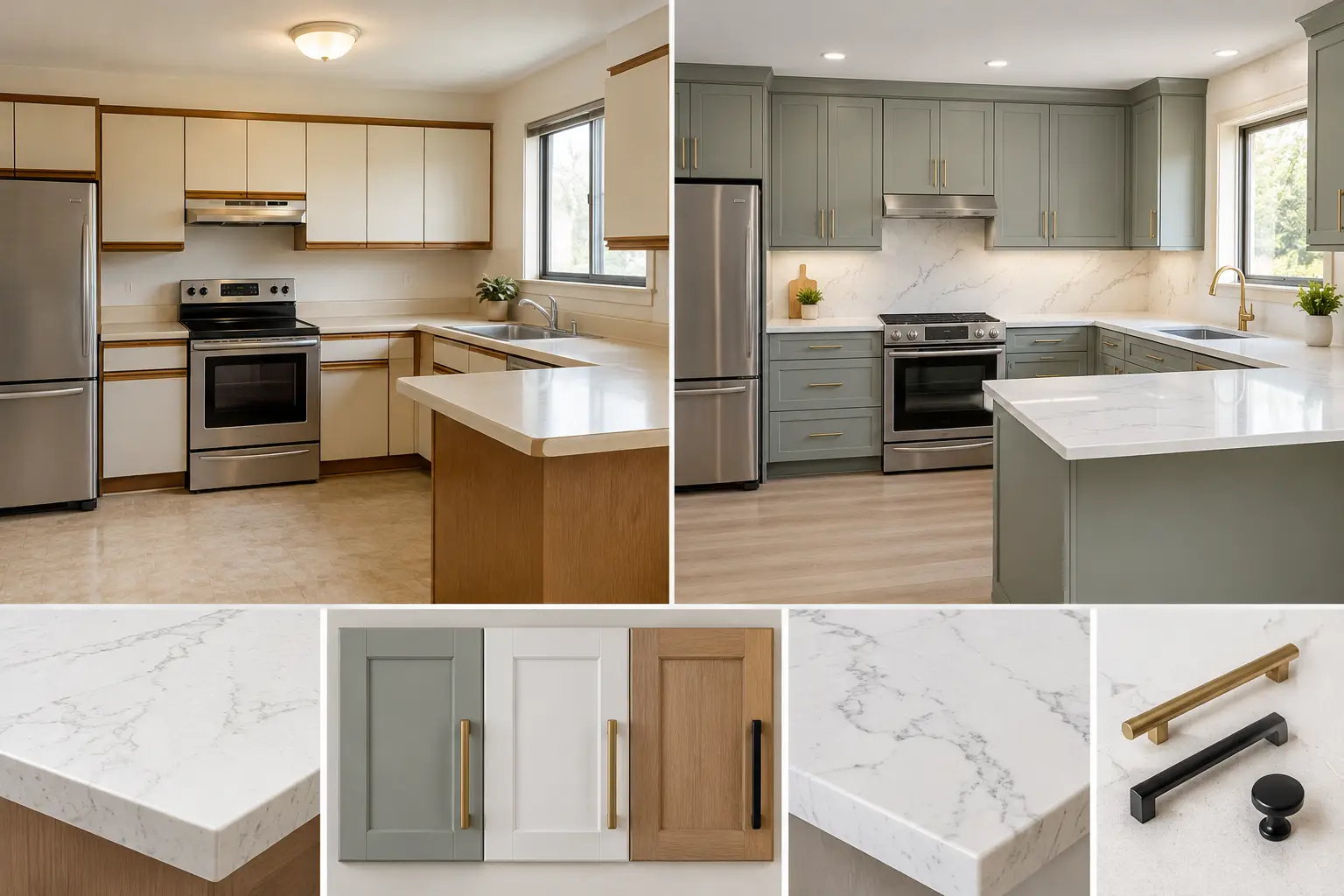
Structural compatibility is essential, but visual compatibility is where the transformation becomes personal. Quartz can range from quiet white with soft movement to bold veining, warm beige tones, charcoal patterns, and dramatic dark surfaces. The right cabinet finish should support the stone rather than compete with it.
For a heavily veined quartz, a simpler door style and calmer cabinet color often create the most confident result. Shaker doors in a warm white, soft taupe, or natural wood tone can give the countertop room to stand out. If the quartz is subtle, you have more freedom to introduce contrast through cabinetry, hardware, or a deeper island finish.
Lighting changes the conversation. Samples should be viewed in the actual kitchen, under natural daylight and your existing overhead lighting. What looks crisp in a showroom can read warmer at home, especially beside flooring, wall paint, and backsplash tile. Physical samples make these choices easier because you can compare them directly where the finished kitchen will live.
Questions worth answering before you commit
Before choosing a quartz slab or a cabinet finish, get clear answers about the condition of your cabinet boxes, whether the existing countertop will stay or go, and whether you want any functional changes. It also helps to decide early if you are replacing the sink, faucet, backsplash, or appliances. Each decision can affect measurements and installation timing.
Ask how the countertop will be protected during any demolition that is required. Ask when final measurements will happen and who coordinates the cabinet readiness before templating. If you are retaining existing quartz, ask how new panels, doors, and drawer fronts will be fitted around it. Clear answers are a sign that the project is being planned as a whole rather than treated as a collection of separate tasks.
A smarter path to a finished kitchen
Quartz countertop compatibility is rarely a simple yes-or-no question. It is a practical review of what your kitchen already has, what you want it to do better, and which changes will deliver the greatest impact without unnecessary disruption.
When your cabinet boxes are sound and your kitchen footprint still serves your household, refacing can be an intelligent way to build around new or existing quartz. With proper assessment, precise measuring, and thoughtful material selections, you can keep the strengths of your kitchen and enjoy a finish that feels entirely new. Grab a cup of your favorite beverage, look at what already works in your space, and start with a plan that respects it.