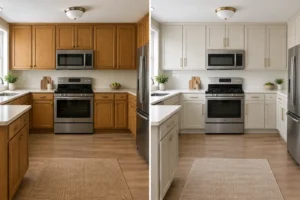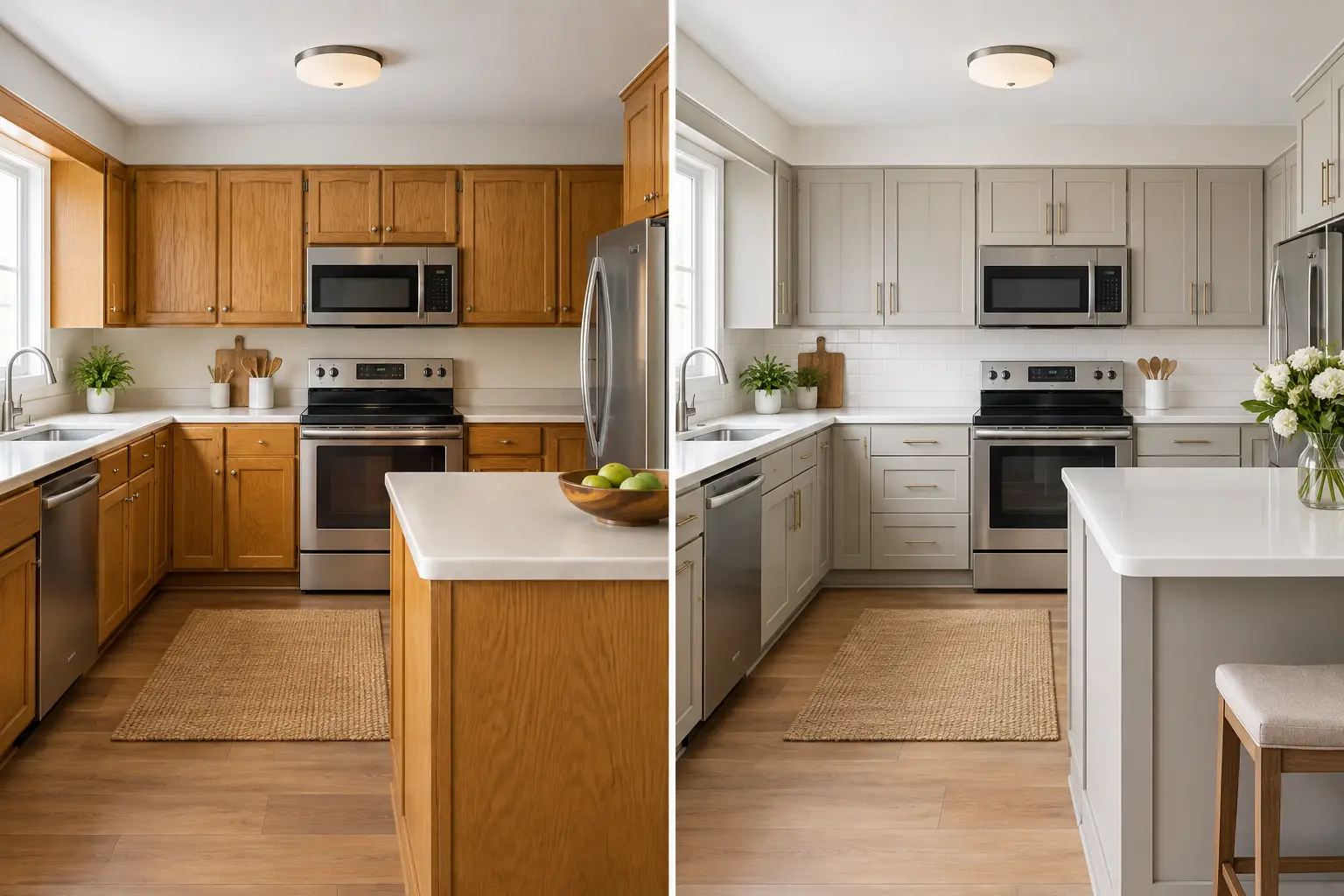
A kitchen can feel dated long before it stops working. Maybe the cabinet boxes are solid, the layout still suits your family, and the countertops are worth keeping – but the honey-oak doors, worn finish, or tired hardware no longer reflect your home. That is usually when homeowners ask: what is kitchen cabinet refinishing, and is it enough to create the kitchen they want?
The honest answer is that refinishing can be a meaningful update in the right kitchen. But it is often confused with cabinet refacing, and the difference matters. The best choice depends on the condition of your cabinetry, the look you want, and how much change your kitchen truly needs.
Kitchen Facelift is your planning expert if you live in the Greater Hamilton Area.
Click to see the map for the area (Oakville to Hamilton to Niagara and north to Milton).
What Is Kitchen Cabinet Refinishing?
Kitchen cabinet refinishing means renewing the finish on your existing cabinet doors, drawer fronts, and sometimes the visible exterior surfaces of the cabinet boxes. Rather than replacing components, the goal is to improve what is already there.
The process can involve deep cleaning, repairing minor surface damage, sanding or preparing the existing finish, then applying stain, paint, lacquer, or another protective coating. New knobs, pulls, and hinges may be added to complete the update.
Refinishing is most effective when the cabinet doors are in good physical condition and their profile still works with the style you have in mind. A smooth, well-built door may take a painted finish beautifully. On the other hand, a heavily routed 1990s door will still have the same routed shape after it is painted. The color changes, but the door design does not.
That distinction is easy to miss when looking at before-and-after photos. A fresh finish can make a major visual difference, yet it cannot correct worn-out doors, uneven construction, water damage, or a style that no longer feels right for the room.
Refinishing vs. Refacing: The Key Difference
Cabinet refinishing updates the surface of existing doors and drawer fronts. Cabinet refacing replaces those visible moving parts with new, custom-fit doors and drawer fronts while renewing the exposed cabinet surfaces to match.
With refacing, homeowners can choose a completely different door style, finish, and hardware. A traditional raised-panel kitchen can become a clean shaker kitchen. Doors can be converted to drawer banks where the cabinet structure allows. Decorative end panels, valances, and other visible details can be updated so the finished kitchen feels intentional rather than patched together.
The cabinet boxes remain in place, provided they are structurally sound. That is the point: preserve the part of the kitchen that still performs well, and transform the parts you see and touch every day.
For many homes built in the 1980s and 1990s, this is a particularly practical approach. Those kitchens often have sturdy cabinetry and a layout that still makes sense, but dated door profiles and finishes. Replacing everything may create unnecessary demolition, while simply refinishing may not create enough of a change. Refacing sits between those two options.
When Refinishing Is a Good Fit
Refinishing can make sense when your goals are primarily cosmetic. If you like your existing door style, the doors close properly, and there is no significant swelling, peeling, cracking, or moisture damage, a new finish may be all the kitchen needs.
It can also be a reasonable choice for homeowners who want to preserve an existing wood species or maintain a particular character in the home. Some kitchens look best with their original doors restored rather than redesigned.
Still, refinishing has limits. Dark stain may be difficult to lighten evenly. Cabinet surfaces near the sink, dishwasher, or stove may have accumulated damage that cannot be fully disguised. Painted finishes require careful prep and a controlled application process to look smooth and last well. A quick coat of paint is not the same thing as a durable cabinet finish.
If your cabinets have thin thermofoil peeling away, particleboard swelling near the sink, loose joints, or doors that have warped, refinishing is unlikely to be the lasting answer. The finish can only perform as well as the surface beneath it.
When Cabinet Refacing Makes More Sense
Refacing is often the better option when you are happy with the kitchen footprint but want it to feel genuinely new. It gives you freedom to change the style of the doors instead of working around the old one.
It is also a smart option if you have countertops you want to keep. Granite and quartz are substantial investments, and removing cabinet boxes beneath existing stone can add complexity and risk. Because refacing works with the existing cabinet structure, it can refresh the room while respecting what is already in place.
Homeowners also choose refacing when they want improvements beyond color. You may want full-extension drawer hardware, soft-close doors, updated panels around an island, or a more practical mix of drawers and doors. These changes can make the kitchen function better without requiring a full tear-out.
At Kitchen Facelift, each project is assessed individually because cabinetry rarely fits into a one-size-fits-all category. The goal is not to sell more work than your home needs. It is to help you choose an approach that will look right, function well, and hold up to everyday life.
What Does the Process Look Like?
A professional refinishing project begins with evaluating the existing cabinetry. The installer should look closely at the door material, finish condition, cabinet-box integrity, and any areas affected by heat or water. This early assessment helps avoid a finish that looks good on day one but disappoints later.
Preparation is the most important part of refinishing. Kitchen surfaces carry years of cooking residue, cleaning products, and hand oils. Doors must be cleaned and properly prepared so the new finish can adhere. Repairs and sanding come next, followed by the finishing system selected for the material and desired appearance.
Refacing follows a different path. Existing doors and drawer fronts are removed, the cabinet boxes are prepared, and custom-made replacement components are installed with matched finishes and hardware. Depending on the scope, modest adjustments can also be made for new appliances, backsplash removal, or countertop plans.
A well-organized refacing project can often be completed in just a few days. That matters if your kitchen is the center of a busy household. You still need thoughtful planning and skilled installation, but you do not have to live through the disruption of a full demolition when your existing cabinetry is worth preserving.
Questions to Ask Before You Decide
Before choosing refinishing or refacing, look beyond the color sample. Ask whether you like the shape of your current doors, not just their current finish. Consider whether the boxes are solid, whether the layout works, and whether any problem areas need more than a surface update.
It also helps to think about your next kitchen decisions. Are you planning new quartz countertops? Do you want to replace a worn backsplash? Would more drawers make weeknight cooking easier? A cabinet update should work with those plans rather than limit them.
Finally, ask how the finish or replacement doors will be made and installed. Craftsmanship shows up in the details: consistent reveals around doors, clean edges at panels, durable hardware, thoughtful protection for surrounding surfaces, and a crew that treats your home with care.
The Right Update Is the One That Respects What Works
Kitchen cabinet refinishing is not a lesser version of a renovation. In the right setting, it is a focused way to bring worn cabinetry back to life. But when the door style, functionality, or condition of the cabinets is holding the kitchen back, refacing may offer the more complete transformation.
Start with what you want to keep. If the layout works, the boxes are solid, and you want a beautiful change without unnecessary disruption, there is often a smarter path than starting over. A clear, professional assessment can turn a kitchen decision that feels overwhelming into one that feels refreshingly straightforward.